The Visibility Game is Rigged.
The More You Know ✨

 
cool-background.png

You’ve been told,

show up in front of enough of the right people—in their social feeds, at their networking events, in their publications—and your ideas and/or work will click, catch on and command buy in.

So why does it feel like you're working twice as hard, and thrice as smart, for half as much influence?

Well, it’s because you are.

Sorry.

Influence: The capacity to shape the beliefs, judgements and actions of others.

(let’s make sure we’re on the same page.)

Here’s the Math:

Current approaches to building visibility and influence aren't built for the way human brains work. They're built for the way algorithms work.

When you and your team are doing their best, showing up in all of the right places--or at least trying to--you're only focusing on the first “R” of visibility.

And that first R doesn’t lead to influence, despite everything you’ve been told.

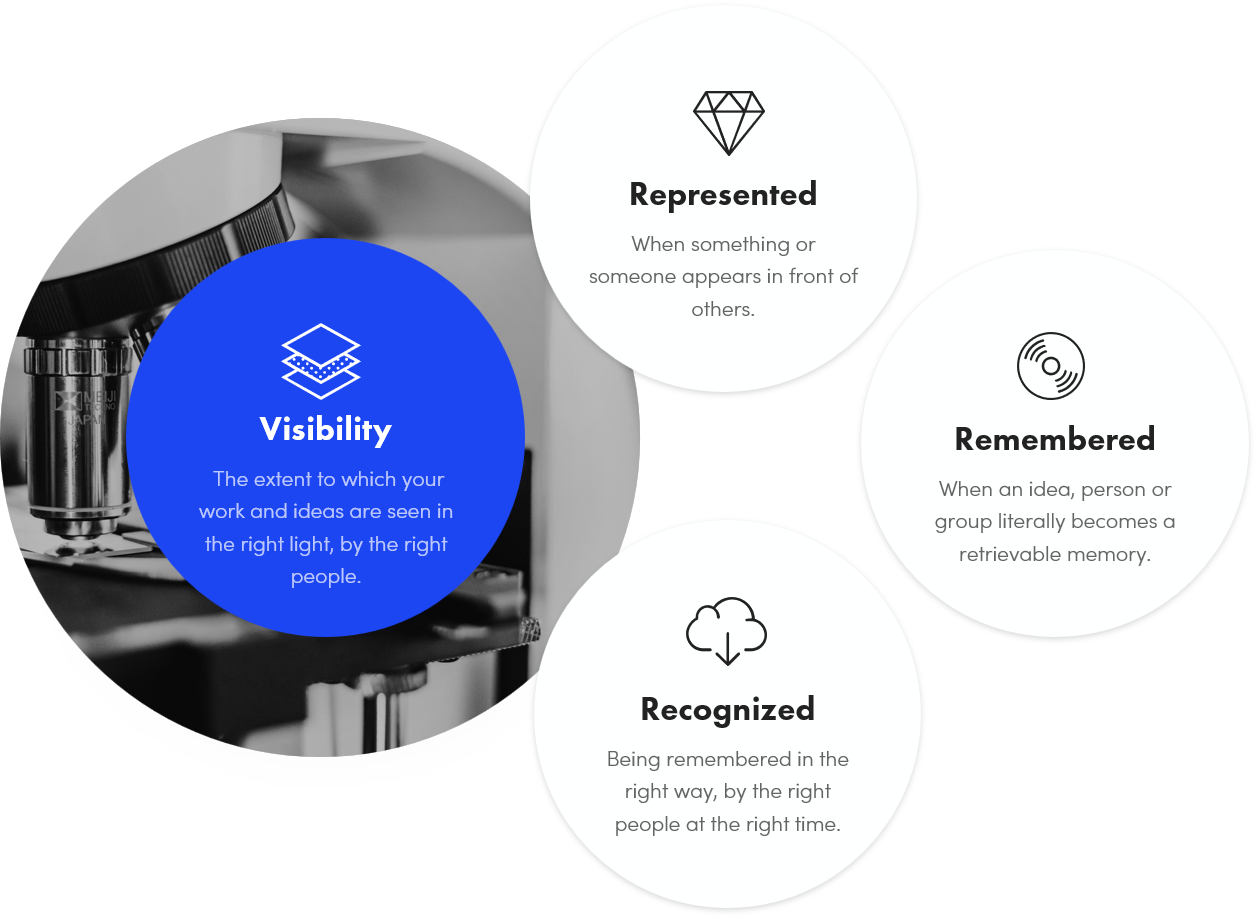
The 3 Rs of Visibility

  The First R  

The first R of Visibility is “Represented.” Representation is hugely important. But being represented doesn't always mean you're seen. The same way handing you a microphone isn't the same as people hearing you.

Curious about what's actually happening in the brain?

When something is represented, it's picked up by 1 or more of our senses and gets processed by the brain. More specifically, it comes face to face with our brains' kung fu filters. ​ ​Being represented means you've got a shot at getting by--it's the minimum viable. But it doesn't guarantee safe passage to the other side. That's why the 2nd R of Visibility is so important.


  The Second R  

For the especially enlightened, we might go beyond representation and focus on being memorable. That's the second R of visibility: Remembered. With this R, we are beginning to address how human brains work. The problem that arises is what we're being remembered for. Being memorable doesn't mean being remembered in the right light and it certainly doesn't mean being remembered at the right time either.

Curious about what's actually happening in the brain?

Once an idea is past the kung fu filters (see the toggle above for more details), it gets stored in our long-term memory. Think of your long term memory as a galaxy… and each memory, a star. There are neighborhoods of stars. Groupings. Constellations. When something is remembered, it is placed in one of these constellation. ​ ​

This doesn’t mean you’re stored in the right constellation. You can be remembered by the wrong people. At the wrong moments, for the wrong reasons. That's why, ultimately, the 3rd R of Visibility is the gold standard as far as the brain is concerned.

This is where those traditional approaches begin to fall short. Worse yet, they don’t account for little things like systemic visibility biases—the learned brain chemistry in our heads that allocates our attention in discriminatory ways.

So if folks are, say, 33% more likely to overlook you[1] or the communities you represent, it's fair to say the typical approaches to building, managing and raising the profile of an idea or approach won’t work as well.

So why do we pretend that they do?


Because we've completely overlooked The Third R of visibility: Recognition.

We've been told wanting recognition is needy. That it gives away our power. That the strength of our ideas will speak for themselves.

Recognition is simply when something or someone is remembered by the right people, at the right time in the right way and the acknowledgement that arrives in response to that.

Curious about what's actually happening in the brain?

Recognition is both a cognitive state and a behavior.

The Cognitive State: Being remembered in the right way at the right time by the right people. When people sit down to make decisions, they consult their long term memory--that galaxy of stars. More specifically, they pull up a star map of the relevant neighborhoods or constellations and consider it as they make that decision. Being recognized means being on that star map. The one people pull up as they decide to move forward.

The Behavior: Acknowledgement of the importance of one's ideas, work, person or contributions.

Working Consolidated Definition: a behavior of retrieval and acknowledgment in response to a relevant cue.

You can't have influence without recognition.

[1] This is a real thing. It’s a result of the visibility bias called the Racial Attention Deficit.


On Underrecognition.


This just in: you’re short on influence

(read also: recognition)

Also breaking: it’s not your fault.

When you (or the communities you’re looking to elevate) are underrecognized (read: if you’re here, then you are), you face systemic barriers to visibility, influence and success. Full Stop. And if you're trying to make the world a better place at the same time? You've got a triple bind:

  1. People have been conditioned to ignore you. Attention is literally allocated away from you (visibility bias).

  2. It actually costs you more to pursue greater visibility (The Invisibility Tax)

  3. This status quo has learned brain chemistry on it's side

That isn’t an accident. It’s a centuries old feature. Conclusion? Cookie Cutter isn’t going to cut it.

Nobi Triangle.png
 
 
More details (for the nerds)

Ever been told to ditch your imposter syndrome?

*deep breath*

Putting aside the very well documented reasons why using the term “syndrome” is deeply problematic, underrecognition as well as its causes and costs demonstrate that Imposter Syndrome is a long con.

​It’s Accountability Laundering of the most egregious kind.

​An “individualization of responsibility” we’ve seen before with the climate crisis. Remember the influence campaign our most culpable companies leveraged to burden us with the task of reducing, reusing and recycling our way out of their monstrous environmental negligence?

Well, in like fashion, you’ve never just happened to feel like an imposter.

​You'd had that burden foisted upon you.

You were dealing with the Imposter Complex—as in the Imposter Industrial Complex.

​It is a system of people, structures and conventions deeply invested in certain people feeling like imposters. In its targets dissipating their energy with that emotional hurdle.

The penalty levied against you was likely a kind of Credibility Shakedown. You’ve been told to pay up—to give more in qualifications than your typically recognized peers—in order to be deemed competent.

That’s an Invisibility Tax.

The huge mistake traditional visibility and influence work makes is not accounting for the visibility biases you face as an historically underrecognized leader and the Invisibility Tax you pay as a result.

Don’t even get us started on Backlash and Likability Heuristics…

Your experience may include…


Reciprocity Gap

A Reciprocity Ransom

This is a consequence of the Reciprocity Gap—disparities in returns on social investments between groups, largely determined by worth and cultural membership in a society. Underrecognized folks are often asked to meet a higher threshold of investment in order to activate a willingness to reciprocate. Translation: Getting less than your peers because of a marginalized identity.

 
undraw_Powerful_re_frhr.png

A Validation Paradox

That unenviable position wickedly smart and constantly overworking leaders from underrecognized communities often find themselves in: validated—in the rooms where decisions are made and shots are called, but only as a token or a figurehead. Sentenced to posing gratefully for the opportunity to lead with very little actual power or influence.

 
undraw_like_dislike_1dfj.png

An Ambition Penalty

The sum total of social, professional and financial costs the underrecognized face for their ambition (h/t Stefanie O’Connell). Often mislabeled as a “Confidence Gap,” in women and girls.


or something we haven’t even discovered yet.


Conclusion: most approaches aren’t set up to get your work better seen, understood and trusted BECAUSE they aren’t built to overcome visibility biases and the Invisibility Tax. So, if we want to turn up the influence of your ideas, if we want them to spread at a societal level, we have to approach doing so with both in mind.

We need to up your recognition.


How? Here’s the Play by Play

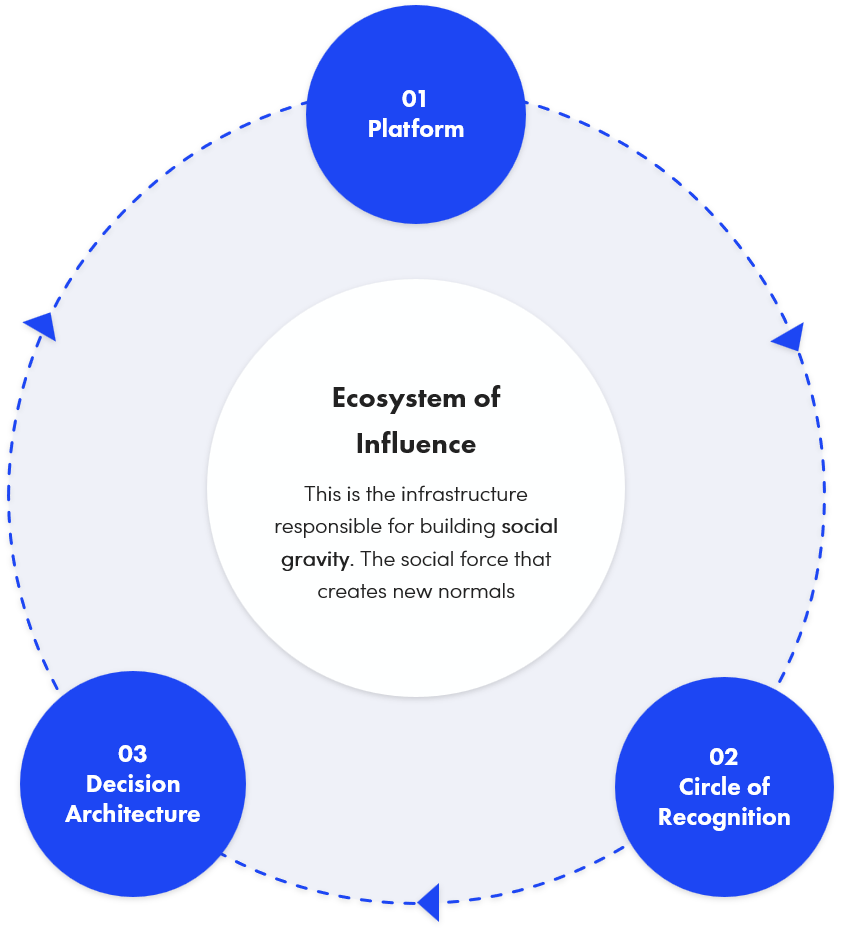
  1. We build a platform that actually takes into account how human brains work. Leveraging the four forces that drive all behavior.

  2. We cultivate a Circle of Recognition that strategically connects you to the people, communities, and decision-making spaces from which recognition, endorsement and opportunities originate and spread.

  3. We design Decision Architecture to nudge every stakeholder towards the behaviors that will build your momentum into social gravity

NobiWorks does all of this leveraging a systematic understanding of human behavior and an equally rigorous measurement of the distribution of power around you.

 
do this instead-07.jpg

What's this about a brand scientist?

What's this about a brand scientist?

Oh hey! That’s me.

I’m N. Chloé, a brand scientist and digital diplomacy (actual diplomacy!) advisor. I’ve advised everyone from small island nations and the first refugee delegation to the UN to small, black owned mom and pop shops. And all of them were socially innovative brands ready to give the status quo a good shove.

That mom and pop shop? Brad Pitt’s now a fan. That small island nation? The coalition of countries they formed just got kudos from President Obama at the COP26 conference. Can I promise these results? No. But I can promise that the same methods I developed as an international conflict mediator–the very same methods I used with these clients–are what I will bring to bear in our engagement. 

How exactly did a Conflict Mediator become The Brand Scientist?

It actually started with building my first computer.

I was maybe 10 years old and quickly realized I had a knack for figuring “this stuff” out.

Over a decade later, with (bafflingly) a degree in (neuro)philosophy, political theology and Japanese of all things, I sat at a desk in an Israeli non profit, presenting a quick website I’d coded to a small group of my supervisors.

Sure, being the young person in a public sector organization meant I was also on tech duty, but this crew had not actually expected me to be some sort of high functioning tech nerd. Once the cat was out of the bag, tiny non profits and advocacy groups all over the world ended up requesting my support. Some of that work supported me through mediation grad school.

A few years after finally becoming a conflict mediator (why yes, that is social psychology in high stakes situations), I had a crisis of faith.

I’d become a mediator because of it’s potential for initiating power parity. Leveling the playing field. But as I facilitated these high level discussions, I realized that certain folks weren't even getting to the negotiating table.

Mediation is a voluntary process, so a group with power usually only negotiates with an actor they are unable to overlook. And in global conflict there are tons of folks we're "able to overlook" who *should* be at those tables in order for the change to stick sustainably and equitably.

So I decided I would help make those folks impossible to ignore.

I returned to my tech nerd powered roots to do it.

And realized brands were the key soon after.

That’s how NobiWorks was born.

This lab tends to attract trendsetters and innovators, so if that sounds like you, welcome; you’re already my favorite kind of person.

We’re absolutely going to get into all sorts of trouble together.
 

What's all this about brands?

A brand is a system of ideas that influences the behaviors of others.

(a bit different from what you’ve heard before, no?)

Said another way, brands are a kind of influential real estate in someone’s head. Remember the galaxy of stars and it’s constellations? Think of brands as a kind of star or even a kind of constellation. In the international politics set. brands are also resources of something we call “soft power.” It’s why you knew not to make certain moves with Germany or France—because their brands informed you how they would respond. It’s why brands can become legacies. Soft power, involves the use of appeal, attraction and persuasion to achieve objectives and to shape the preferences of others—which is exactly what effective brands do.

But you’ve got to be noticed and remembered and ultimately recognized for any of that to work. And recent studies are empirically demonstrating that underestimated people are and have been systematically underrecognized, overlooked and undervalued. Translation? Society has been conditioned to ignore us.

The huge mistake traditional brand work makes is not accounting for the visibility biases you face as an historically underestimated leader and the Invisibility Tax you pay as a result.

Don’t even get us started on Backlash and Likability Heuristics…

Enter Recognition Equity.

Recognition equity is a quantifiable status. It is the point at which we reach a critical mass of influential, underrecognized leaders strategically positioned for ultimate social impact. We’re not there yet—otherwise your ideas would already be catching on. But that is the vision this lab has for the world.

Because we grew tired of optics.

And representation is the bare minimum we should accept.


what's next?


Image Source: Getty / Anchiy
consult the navigator

Answer a couple of our director’s questions and you’ll be guided directly to your best next step. Promise.


The Promise
 
social.jpeg
we love collaboration

partnership is built into our process. we guarantee you’ll love what you get.

 
client+portal+web+design
we've made it easy

the process couldn’t be easier. your client portal will keep everything in one place.

 
work on time website
nothing's arbitrary

everything we do, every choice we make or advise you to make is backed by science and rigerous equity standards.


A majority of my clients are based in the US, and so investments are quoted in USD. However, as I work with clients across the globe, I invite my international clients to utilize this currency converter or another of their choosing for an estimation of what these numbers mean locally.